Improving Student Language & Literacy Skills:
A Study of the Effectiveness of ABC Music & Me
Overview
To evaluate the effectiveness of Kindermusik’s ABC Music & Me curriculum, an independent research firm, SEG Measurement, conducted a national, multi-site study* following 299 preschool children during the 2012-13 school year. ABC Music & Me is a supplemental early childhood curriculum that uses music and movement to engage young children while teaching a variety of skills critical to later school success. Extensive at-home materials, provided to parents monthly with each new curriculum unit, inform families of their children’s classroom experiences and provide the means for continuing classroom learning at home.
 The findings indicate that students in classes using the ABC Music & Me program made significantly greater gains in language and literacy skills as compared to students in classes that did not use any of the ABC Music & Me program components.
Study Design
The study examined the effectiveness of the ABC Music & Me program by comparing the growth in language and literacy skills among preschool students receiving the ABC Music & Me curriculum to a comparable group of preschoolers who did not receive the ABC Music & Me program.
The study incorporated a pre- and post-test treatment- and control-group design. All participating students took the Phonological Awareness Literacy Screening (PALS) Pre-K Assessment** at both the beginning and end of the school year. Students in the treatment group received ABC Music & Me instruction and activities as part of their preschool curriculum during the school year. Students in the control group did not receive any ABC Music & Me instruction or activities.
Students in the control and treatment groups attended the same or comparable schools, and statistical analyses were conducted to ensure that the groups were comparable. Analysis of Covariance was used to compare treatment and control-group performance on the post-test while controlling for any initial differences in ability.
Teacher and parent feedback regarding ABC Music & Me was also collected through biweekly teacher surveys on curriculum usage, an end-of-year teacher survey, a classroom environment survey, and two parent surveys investigating families’ use of the ABC Music & Me Home Materials.
Results
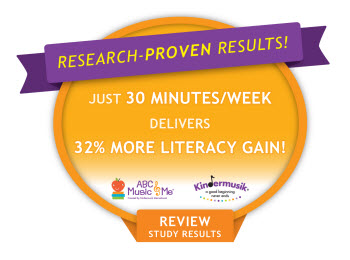
The results of the study show that students who received ABC Music & Me instruction showed significantly larger gains on the PALS test than did students who did not receive ABC Music & Me instruction. In fact, ABC Music & Me students showed 32% more improvement on the PALS test than did control group students. These results indicate that the ABC Music & Me program successfully boosts preschoolers’ language and literacy skills.
 Results from teacher surveys indicate that preschool teachers found the ABC Music & Me curriculum to be effective in teaching a variety of skills, and would strongly recommend it to other preschool teachers, and that parents would recommend the program to other parents.
Conclusions
Students who participated in ABC Music & Me showed significantly greater gains in language and literacy skills than students who did not receive ABC Music & Me instruction.
Teachers who used ABC Music & Me found the program to be effective in many areas. Both teachers and parents would strongly recommend the program to others.
*This study was conducted by SEG Measurement, supported by a grant from Kindermusik International. SEG is an independent research firm, providing research services to educational publishers, technology providers, and government agencies, since 1979.
**About PALS: The PALS-(Phonological Awareness Literacy Screening (PALS) Pre-K Assessment is a scientifically-based phonological awareness and literacy screening that measures preschoolers’ developing knowledge of important literacy fundamentals and offers guidance to teachers for tailoring instruction to children’s specific needs. The assessment reflects skills that are predictive of future reading success and measures name writing ability, upper-case and lower-case alphabet recognition, letter sound and beginning sound production, print and word awareness, rhyme awareness and nursery rhyme awareness.
View a Summary of the Report
View the Full Report




 Regular schedules provide a framework that orders a young child’s world. While predictability can be tedious for adults, children thrive on sameness and repetition. “Knowing what to expect from relationships and activities helps children become more confident,” says Dr. Peter Gorski, assistant professor of pediatrics at Harvard Medical School (Asher).
 Music classes in the early years that include parental involvement and focus on learning in a fun, developmentally appropriate way inspire a lifelong love for learning.




 Why teach Kindermusik? There are many benefits of